Blood on the Highway: The Jeepney Driver’s Revenge That Shocked an Entire City
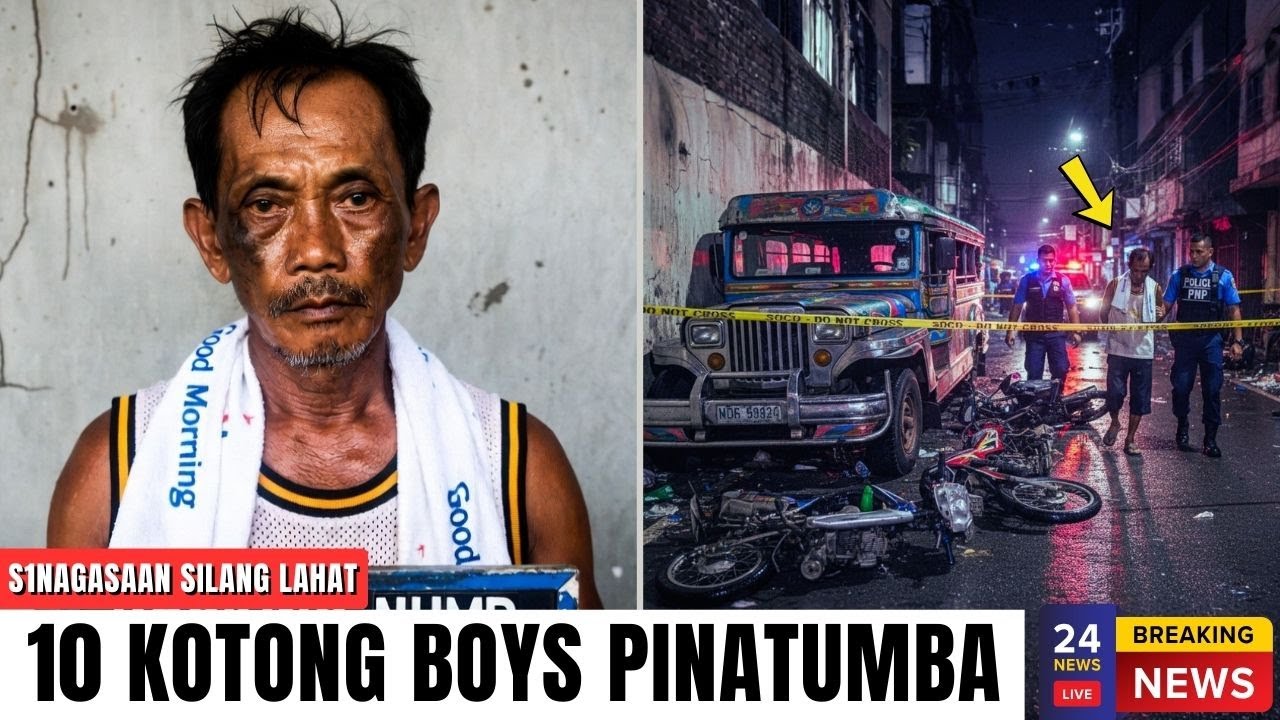
10 Kotong Boys Shot Dead: A Jeepney Driver’s Brutal Revenge for His Slain Conductor
The city woke up to sirens, shattered glass, and questions no one was ready to answer. What began as another ordinary night on the road ended in bloodshed that would haunt an entire community. Ten young men—known on the streets as “kotong boys,” notorious for extorting drivers—were found dead after a violent encounter that authorities now describe as one of the most shocking acts of vigilante revenge in recent memory.
At the center of the story is a jeepney driver named Manuel Reyes, a man once known by passengers as quiet, polite, and hardworking. For years, Manuel drove the same route, day and night, alongside his conductor, Joel Santos. They shared meals, stories, and dreams of a better life. No one imagined that grief would eventually turn Manuel into the most talked-about name in the city.
A Routine Night That Turned Deadly
According to police reports, the tragedy began three nights earlier when Joel Santos was fatally stabbed during an altercation at an illegal checkpoint. Witnesses claimed a group of young men blocked the jeepney, demanding money—an all-too-common practice drivers had learned to tolerate out of fear. That night, however, something went wrong.
An argument erupted. Voices were raised. Then came the knife.
Joel collapsed on the pavement, bleeding as passengers screamed for help. The attackers fled into the darkness, leaving Manuel kneeling beside his dying friend. By the time emergency responders arrived, Joel was gone.
For Manuel, that moment marked the end of the life he once knew.
Grief, Anger, and Silence
In the days following the killing, Manuel barely spoke. Neighbors described him as “empty” and “broken.” He attended Joel’s wake without shedding a tear, staring at the coffin as if his soul had already left his body.
Friends urged him to trust the law. Police promised an investigation. But on the streets, everyone knew the truth: cases like this rarely found justice. The same group of kotong boys had terrorized drivers for years, protected by fear, silence, and the chaos of the night.
What no one realized was that Manuel had already made a decision.
The Night of Revenge
CCTV footage reviewed by investigators shows Manuel’s jeepney leaving its usual route late at night. Inside, there were no passengers—only a man driven by rage and sorrow. Authorities believe Manuel tracked down the group responsible for Joel’s death, luring them to an abandoned area under the pretense of paying protection money.
What happened next unfolded with terrifying speed.
Gunshots echoed through the empty streets. One by one, the kotong boys fell. By the time police arrived, ten bodies lay on the ground, the air thick with smoke and silence.
Manuel was found sitting near his jeepney, hands shaking, weapon on the pavement. He did not resist arrest.
A City Divided
News of the massacre spread rapidly, igniting fierce debate across the city and online. Some called Manuel a cold-blooded killer who took the law into his own hands. Others, disturbingly, hailed him as a hero—a man who did what authorities failed to do.
For jeepney drivers, the emotions were complicated. Many admitted they understood Manuel’s pain all too well. “We live in fear every night,” one driver said. “We pay because we want to go home alive.”
Human rights groups, however, issued strong warnings. “Violence cannot be justified, no matter the reason,” a spokesperson said. “This is a failure of the system, not a victory.”
Inside Manuel’s Mind
During questioning, Manuel reportedly broke down for the first time since Joel’s death. He spoke of sleepless nights, of hearing his friend’s voice, of replaying the moment he failed to save him. “I lost my brother,” he told investigators. “That night, something inside me died too.”
Psychologists consulted by the police suggest Manuel experienced a psychological break triggered by trauma and prolonged fear. “This was not a calculated criminal act,” one expert noted. “It was an explosion of unresolved grief and anger.”
Still, the law does not bend for pain.
The Legal Battle Ahead
Manuel now faces multiple counts of homicide. Prosecutors have made it clear: sympathy will not erase responsibility. If convicted, he could spend the rest of his life behind bars.
Joel’s family, meanwhile, is caught between grief and confusion. “We lost Joel,” his sister said through tears. “Now we might lose another life to this tragedy.”
The families of the slain kotong boys have also come forward, some insisting their sons were misunderstood, others admitting they had fallen into dangerous paths. For them, justice feels just as distant.
A System Under Fire
Beyond the headlines, this case has exposed deeper cracks in society—corruption, poverty, and the daily dangers faced by those who keep the city moving. Why did illegal checkpoints exist unchecked? Why did drivers feel abandoned by the law?
City officials have promised reforms, increased patrols, and stricter enforcement. But for many, these promises come too late.
A Tragic Warning
This is not a story of victory or defeat. It is a story of loss—of a conductor who never came home, of a driver who lost his soul, and of young lives wasted on both sides of the gun.
As the city moves forward, one question lingers in the air: how many more tragedies will it take before fear no longer rules the streets?
For now, the jeepney routes remain open, engines running, drivers alert. And somewhere behind bars, Manuel Reyes waits—haunted by a single moment that changed everything.