
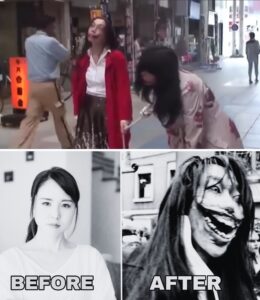
**“AM I BEAUTIFUL?”
The Chilling Legend of Japan’s Slit-Mouthed Woman**
On a quiet street in Japan, late at night, footsteps echo softly under dim streetlights. The air is still, almost peaceful—until a woman approaches. She is well-dressed, polite, and wears a surgical mask covering her mouth. Her eyes are calm, almost kind. Then she asks a simple question in a gentle voice:
“Am I beautiful?”
This question, innocent on the surface, has become one of the most terrifying phrases in Japanese folklore. It belongs to Kuchisake-onna, the “Slit-Mouthed Woman,” a figure whose legend has haunted Japan for decades and continues to send chills down the spines of those who hear her story.
THE ORIGIN OF THE LEGEND
The tale of Kuchisake-onna is believed to have roots in Japanese urban legends from the late 20th century, though some versions trace her origins much further back. In many retellings, she was once a beautiful woman—admired, envied, and desired. Her beauty, however, became the cause of her downfall.
According to the most common version of the story, she was married to a jealous and violent husband. Consumed by suspicion and rage, he accused her of infidelity. In a moment of brutal anger, he slashed her mouth from ear to ear, disfiguring her face and forever destroying the beauty he once claimed to love. As she bled, he screamed, “Who will think you’re beautiful now?”
She died from her injuries—or, in some versions, lived in unbearable shame. But death did not end her suffering. Her spirit returned, twisted by pain, humiliation, and rage, roaming the streets in search of answers to the question that defined her tragedy.
THE QUESTION THAT DECIDES YOUR FATE
Kuchisake-onna is said to approach her victims—often lone pedestrians, sometimes children—and ask, “Am I beautiful?”
The danger lies not in the question itself, but in the answer.
If you say “No,” the legend says she will attack you on the spot, enraged by rejection.
If you say “Yes,” she removes her mask, revealing a mouth grotesquely split from ear to ear, and asks again, “How about now?”
At this moment, fear paralyzes most victims. According to the legend, answering “No” leads to immediate death. Answering “Yes” may still seal your fate, as she may believe you are lying—or decide to make you “beautiful” just like her.
Some stories say she cuts the victim’s mouth to resemble hers. Others claim she simply disappears, leaving behind trauma that lasts a lifetime.
CAN YOU ESCAPE?
Over time, Japanese folklore has developed supposed “survival tactics” to escape Kuchisake-onna. One method is to answer ambiguously, such as “You’re average,” confusing her long enough to flee. Another involves throwing candy or money on the ground—items said to distract her due to unresolved attachments from her past life.
Whether these tactics are real or simply comforting myths, they reveal something deeper: the legend evolved as people tried to regain control over a story that terrified them.
THE PANIC OF THE 1970s
In the late 1970s, Japan experienced a wave of mass hysteria linked to Kuchisake-onna. Reports of sightings spread rapidly through schools and neighborhoods. Children were warned not to walk home alone. Some schools organized group escorts, and parents waited anxiously at gates.
Newspapers at the time reported alleged encounters, describing women matching the legend’s appearance. While no concrete evidence ever confirmed her existence, the fear was very real. The legend blurred the line between folklore and reality, embedding itself deeply into public consciousness.
A REFLECTION OF SOCIETY’S FEARS
Why did this legend become so powerful?
Experts suggest that Kuchisake-onna represents deeper societal anxieties. Her story reflects fears surrounding beauty standards, domestic violence, and the consequences of obsession and jealousy. The surgical mask—common in Japan even before modern pandemics—adds an unsettling realism, making her appearance plausible and terrifyingly ordinary.
She is not a monster with claws or fangs. She is human. And that is what makes her so frightening.
MODERN ENCOUNTERS AND POP CULTURE
Even today, people claim to see Kuchisake-onna. Social media periodically revives the legend, with viral posts, photos, and stories reigniting fear. Horror films, manga, anime, and video games have reimagined her countless times, each adding new layers to the myth.
Yet no matter how many adaptations exist, the core of the story remains unchanged: a woman asking for validation, forever trapped between beauty and horror.
THE REAL HORROR BEHIND THE MYTH
Perhaps the most disturbing part of the legend is not the violence, but the question itself.
“Am I beautiful?”
It is a question many people ask—seeking approval, reassurance, love. In Kuchisake-onna’s case, the question becomes a weapon, a test, and a curse. Her tragedy lies not only in her physical scars, but in her inability to escape society’s fixation on appearance.
She forces her victims to confront their fear, honesty, and instinct for survival. There is no correct answer—only consequences.
WHY THE LEGEND ENDURES
Kuchisake-onna endures because she embodies unresolved pain. She is a reminder that cruelty leaves scars that can outlive death, and that beauty, when twisted by violence, can become something monstrous.
In a world where appearances still dictate worth, her story remains disturbingly relevant.
So if you ever find yourself alone at night, and a masked woman stops you with a polite smile and a quiet question, remember: the most terrifying things are not always the ones that scream—but the ones that ask softly.
“Am I beautiful?”
News

Coco Martin Finally Breaks His Silence: Ang Tunay na Dahilan sa Biglaang Pag-alis ni Christopher de Leon sa “Batang Quiapo” Ay Mas Malalim Kaysa Inaakala ng Lahat!
COCO MARTIN BINASAG ANG KATAHIMIKAN UKOL SA HULING DESISYON NG PAGTANGGAL KAY CHRISTOPHER DE LEON SA BATANG QUIAPO – MGA LIHIM NA…

🔥 Iniwan si Sara? Lihim na Pagkawatak ng DDS, Isang Pampulitikang Pagsabog sa Likod ng Eksena
Hala! Iniwan si Sara? DDS Nagbaliktaran sa Likod ng Eksena Sa loob ng maraming taon, si Sara ay itinuturing na isa sa…

Mon Tulfo, Kumalas sa Katahimikan: Ang Umano’y “Marcos Destab Plot” na Yumanig sa Pulitika—May Papel ba sina Sara at Pulong Duterte?
“PARA SA KUDETA: Paano BINUKO ni Mon Tulfo ang PLANONG Marcos Destab ni Sara Duterte at Pulong?” Sa loob ng…

HUMAGULGOL SI KARYLLE DAHIL SA INA: Ang Katotohanang Hindi Kailanman Tahasang Inamin ni Zsa Zsa Padilla
**HUMAGULGOL SI KARYLLE DAHIL SA INA: Ano ang HINDI INAAMIN ni ZSA ZSA PADILLA?** Sa likod ng makikinang na ngiti…

Ang Tahimik na Hakbang ni PBBM na Yumanig sa Isipan ng Bayan — Isang Katotohanang Hindi Ibinandera
Ang Tahimik na Ginawa ni PBBM na Nagpabago ng Pananaw ng Marami — Bakit Hindi Ito Naging Balita? Sa mundo…

Alden Richards Tumanggi sa Multi-Million Deal ng TAPE — Ang Tunay na Dahilan sa Likod ng Desisyong Yumanig sa Showbiz!
One of the biggest questions in showbiz right now is Alden Richards’ refusal of an offer from TAPE Inc., the…
End of content
No more pages to load